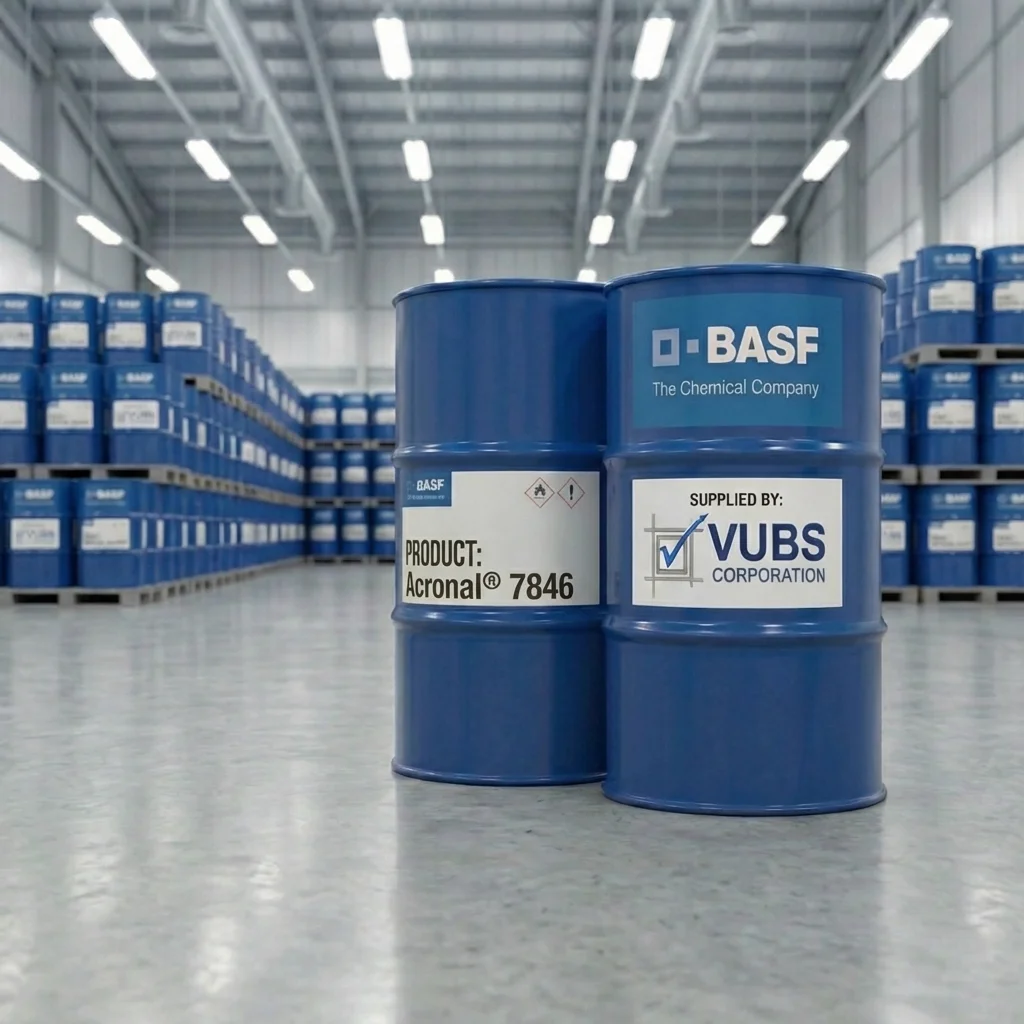
Acronal® 7846
High-Performance Acrylic for Hydraulic Binder Modification
Acronal® 7846 is mainly used to modify hydraulic binders, especially cement mixtures. It is employed in products that have to meet the highest standards of mechanical strength, such as concrete-repair mortars and floor screeds.
Understand in More Detail
This aqueous styrene-acrylate copolymer dispersion is formulated for modifying hydraulic binders in high-performance cement applications. Specifically designed for products requiring exceptional mechanical strength such as concrete repair mortars, floor screeds, and waterproofing applications, it enhances flow properties, workability, adhesion, and durability. The balanced polymer composition integrates effectively into cementitious systems. At VUBS Corporation, we provide comprehensive technical support for Acronal® 7846 implementation, helping customers optimize cement modification formulations for repair mortars, high-strength screeds, and demanding construction applications.
Key Features
Applications
Technical Support and Availability
Acronal® 7846 is available ex-stock at VUBS Corporation with comprehensive technical support. Our team provides formulation guidance, application assistance, and coating system optimization support.
We at VUBS CORPORATION combine BASF's cutting-edge polymer technology with practical application expertise to help you develop superior construction chemical coating systems. Contact us for technical data sheets, starting point formulations, and application-specific recommendations.
Frequently Asked Questions
What makes Acronal® 7846 specifically suited for high-strength repair mortars and screeds?
Acronal® 7846 is a ~48% styrene-acrylic dispersion engineered specifically for hydraulic binder modification where maximum mechanical strength is the primary requirement. The styrene-acrylic chemistry provides exceptional compressive strength enhancement, often achieving 50-100% increases over unmodified cement mortars, which is critical for structural repair applications. The polymer optimizes the cement hydration matrix, creating a denser microstructure with improved particle packing and reduced porosity. This results in superior tensile and flexural strength, essential for crack resistance in floor screeds subject to heavy loads. Enhanced adhesion to old concrete ensures reliable structural bonding in repair applications where delamination is a common failure mode. The product also improves abrasion resistance for industrial flooring exposed to vehicular traffic, forklifts, and heavy machinery. Water resistance is enhanced through reduced permeability, protecting against moisture-related deterioration. The formulation provides an optimal balance between workability for proper placement and finishing, and ultimate mechanical performance for demanding structural applications.
How does polymer-modified mortar compare to traditional cement mortar for concrete repair?
Polymer-modified mortars using Acronal® 7846 offer significant advantages over conventional cement mortars. Mechanical Properties show dramatic improvements: compressive strength increases of 50-100%, tensile strength increases of 100-300%, flexural strength increases of 150-400%, and bond strength to substrate increases of 200-500%. Durability benefits include reduced permeability preventing water and salt ingress, improved freeze-thaw resistance through better air void systems, enhanced chemical resistance to acids and sulfates, and better abrasion resistance extending service life. Application advantages feature improved workability making placement and finishing easier, reduced segregation and bleeding, better adhesion to damp substrates, and thinner application possible due to higher strength. Long-term performance shows reduced shrinkage cracking, better crack-bridging capability, maintained bond integrity under stress, and extended service life reducing maintenance costs. Trade-offs include higher material cost offset by performance benefits, more complex mixing procedures requiring proper sequencing, shorter pot life requiring faster work, and sensitivity to application temperature and humidity. For structural repairs, high-traffic areas, and demanding environments, the performance benefits clearly justify polymer modification.
What is the typical dosage and mixing procedure for creating repair mortars with Acronal® 7846?
Typical dosage ranges from 10-20% by cement weight depending on performance requirements. For standard repair mortars use 10-12%, high-strength structural repairs use 15-18%, and waterproofing screeds with mechanical strength use 18-25%. Mixing procedure is critical: First, dilute Acronal® 7846 with water if needed to achieve target mixing water content. Second, add cement to the polymer-water mixture while mixing continuously with a mechanical mixer. Third, add sand or aggregate gradually while maintaining continuous mixing. Fourth, mix for 3-5 minutes until homogeneous and lump-free. Fifth, allow slurry to rest for 5 minutes then remix briefly before application. Application guidelines specify applying to properly prepared, clean, sound substrates. Dry or highly porous substrates should be dampened but surface-dry. Apply using trowel, brush, or pour-and-spread techniques depending on consistency. Compact thoroughly to eliminate air voids. Cure properly by protecting from rapid moisture loss through misting, wet burlap, or curing compounds. Maintain moderate temperatures (10-30°C) during application and initial curing. Typical formulations include cement (1 part), sand (2-3 parts by weight), Acronal 7846 (10-20% by cement weight), and water (adjusted for workability). VUBS Corporation can provide detailed formulation recipes for specific applications.
Can Acronal® 7846 be used for industrial flooring and what performance standards can be achieved?
Yes, Acronal® 7846 is highly suitable for industrial flooring applications including warehouse floors, manufacturing facilities, logistics centers, and heavy-duty commercial spaces. Performance capabilities include compressive strength exceeding 50 MPa (often 60-80 MPa achievable), flexural strength of 8-15 MPa enabling resistance to point loads, abrasion resistance measured by Böhme method showing minimal wear under traffic, chemical resistance to oils, mild acids, alkalis, and industrial chemicals, and impact resistance preventing spalling from dropped objects or equipment. The polymer-modified screeds can achieve performance classifications including wear resistance class AR 0.5-1.0 (very low wear), compressive strength class C40-C60, and surface hardness suitable for Class 4-5 traffic loads. Applications include heavy forklift traffic areas, automated guided vehicle (AGV) pathways, production line floors, food processing facilities requiring chemical resistance, and cold storage facilities requiring freeze-thaw durability. For optimal performance, proper surface preparation, adequate thickness (typically 30-50mm for industrial loads), proper curing procedures, and consideration of control joints for large areas are essential. VUBS Corporation can provide specifications meeting international standards including EN 13813 for screeds, ACI guidelines for industrial floors, and project-specific performance requirements.
Important Testing & Liability Disclaimer: The technical specifications and performance data presented herein are derived from controlled laboratory conditions and standardized testing environments. Actual performance may vary significantly based on application-specific conditions, formulation variables, environmental factors, and processing parameters. All customers are strongly advised to conduct comprehensive application testing and validation trials prior to commercial-scale production or project deployment. VUBS Corporation supplies products strictly on an "as-is" basis and expressly disclaims all liability for any direct, indirect, incidental, consequential, or punitive damages arising from product use, application, or performance. Customers assume full and sole responsibility for product suitability assessment, application testing, quality control, and all associated risks. Due to strong market demand and limited inventory availability, procurement decisions should be made expeditiously following successful validation testing. For technical consultation and sample procurement, please contact our team.
Interested in Acronal® 7846?
Get technical specifications, request samples, or speak with our experts for application support.
More Polymers for Construction Chemicals
Explore other BASF products in this category
Styrofan® D 623 AP
Admired Worldwide for Consistency and Performance
STYROFAN D 623 of BASF is admired by customers worldwide for its consistency and performance. Products manufactured in the Asia Pacific region by BASF are promoted with the AP suffix, while European products use SE.
Learn MoreStyrofan® ECO 7623
Zero-APEO Styrene-Butadiene Dispersion - Eco-Certified Performance for High-Strength Construction
Styrofan® ECO 7623 is BASF's zero-APEO styrene-butadiene dispersion delivering exceptional strength and water resistance for sustainable construction. With 50-52% solids content and pH 7-9, it excels in flexible tile adhesives, waterproofing mortars, and concrete repair. Meeting Blue Angel and EU Ecolabel standards, it provides superior performance with zero phthalates, formaldehyde, and ammonia.
Learn MoreAcronal® S 400 AP
High-Performance Acrylic Dispersion for Flexible Mortars
VUBS Corporation supplies Acronal® S 400 AP, BASF's premium acrylic dispersion engineered for superior crack-bridging performance in flexible cementitious systems. This versatile polymer delivers exceptional hydraulic binder compatibility, enabling formulators to create high-performance mortars, adhesives, and waterproofing membranes that combine mechanical strength with long-term flexibility. Ideal for demanding applications requiring reliable water resistance and substrate movement accommodation.
Learn More