Acronal® PS 715 I
High-Performance Mastic Waterproofing Membrane Binder
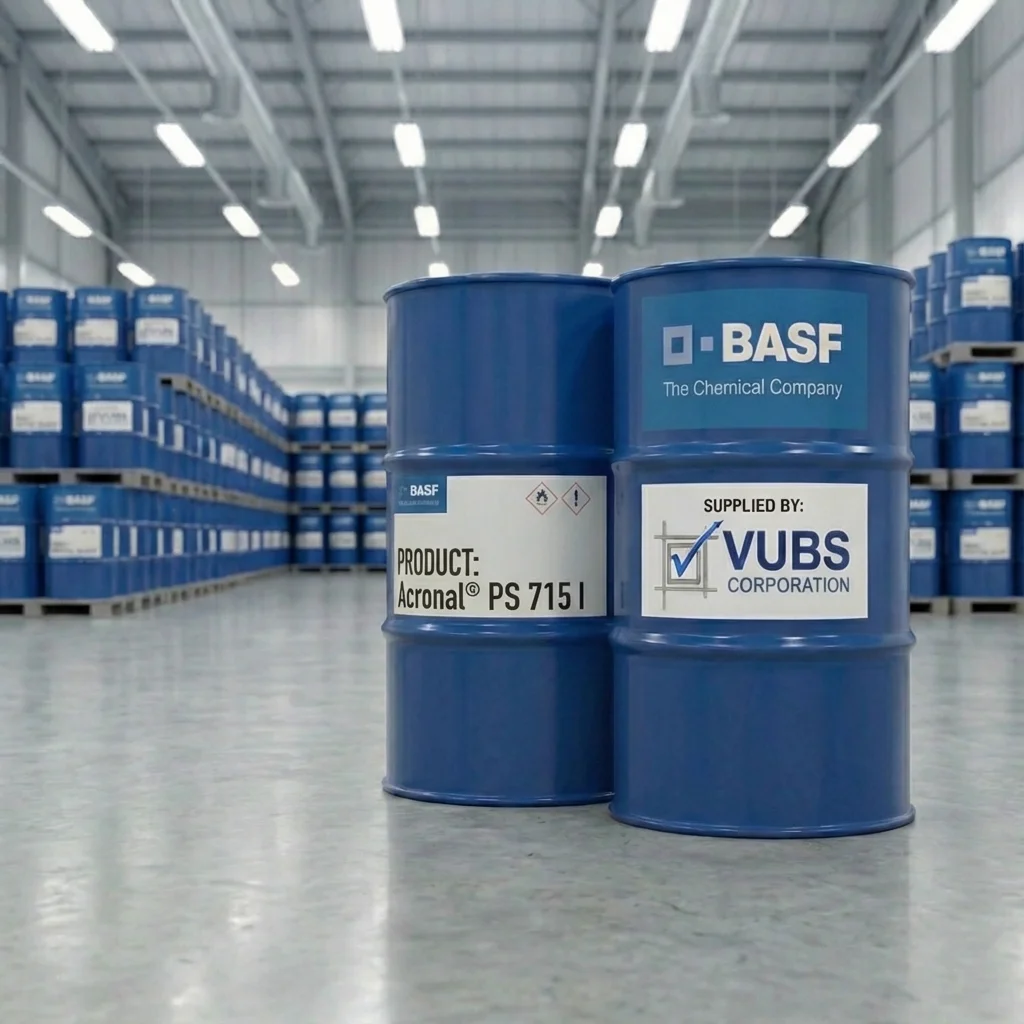
Acronal® PS 715 I is the appropriate binder to be used for high performance mastic waterproofing membranes. Due to its elastomeric and excellent crack-bridging properties it imparts a long-term durability to the building.
Understand in More Detail
This crosslinking styrene-acrylate copolymer dispersion is specifically engineered for elastomeric waterproofing and protective coating systems. Designed for anti-carbonation coatings, mastic waterproofing membranes, and facade protection, it delivers excellent crack-bridging capability, superior adhesion to mineral substrates, and outstanding dirt pickup resistance. The crosslinking functionalities enable ambient temperature curing for enhanced durability. At VUBS Corporation, we provide comprehensive technical support for Acronal® PS 715 I, helping customers develop long-lasting waterproofing systems for building protection, facade applications, and demanding exterior environments where weather resistance is critical.
Key Features
Applications
Technical Specifications
| Parameter | Specification |
|---|---|
| Chemical Nature | Aqueous anionic dispersion of styrene-acrylate copolymer with crosslinking functionalities |
| Solids Content | 49 - 51% |
| pH Value | 9.0 - 10.0 |
| Viscosity at 23°C (DIN EN ISO 2555 RVT) | 1000 - 4000 mPa·s |
| Density | ~1.04 g/cm³ |
| Glass Transition Temperature (Tg) | ~7.5°C |
| Minimum Film Forming Temperature (MFFT) | <5°C |
| Ionic Character | Anionic |
| Crosslinking | Contains crosslinking functionalities for ambient temperature curing |
| APEO Content | Information not specified in available TDS |
| Freeze-Thaw Stability | Not freeze-stable, protect from frost |
| Storage Temperature | 10-30°C in sealed containers |
| Shelf Life | 6-9 months under proper storage conditions |
| Applications | Anti-carbonation coatings, mastic waterproofing, facade protection |
Technical Support and Availability
Acronal® PS 715 I is available ex-stock at VUBS Corporation with comprehensive technical support. Our team provides formulation guidance, application assistance, and exterior coating optimization support.
We at VUBS CORPORATION combine BASF's cutting-edge polymer technology with practical application expertise to help you develop superior weather-resistant coating systems. Contact us for technical data sheets, starting point formulations, and application-specific recommendations.
Frequently Asked Questions
What is carbonation and why is anti-carbonation protection important for concrete?
Carbonation is a chemical process where atmospheric carbon dioxide (CO₂) reacts with calcium hydroxide in concrete, forming calcium carbonate and lowering the concrete's pH from highly alkaline (12-13) to near-neutral levels (8-9). This pH reduction is critical because the high alkalinity of concrete normally protects embedded steel reinforcement from corrosion by maintaining a passive oxide layer on the steel surface. When carbonation reaches the steel depth, this protective layer breaks down, allowing corrosion to initiate. Corroding steel expands, creating internal stresses that cause concrete spalling, cracking, and structural deterioration. Anti-carbonation coatings like those formulated with Acronal® PS 715 I create a protective barrier that significantly reduces CO₂ penetration rates, preserving the concrete's alkalinity and extending the service life of reinforced concrete structures by decades. This is particularly critical for parking structures, bridges, industrial facilities, and urban buildings exposed to high atmospheric CO₂ levels.
How do the crosslinking functionalities in PS 715 I enhance performance?
Acronal® PS 715 I contains reactive crosslinking functionalities that create chemical bonds between polymer chains after film formation. This crosslinking process significantly enhances several critical properties: Film Density increases as the molecular network tightens, creating a more effective barrier against water, CO₂, and aggressive substances; Mechanical Strength improves with better tensile strength, abrasion resistance, and durability under physical stress; Chemical Resistance enhances protection against acids, alkalis, salts, and solvents common in industrial and coastal environments; Crack-Bridging Capability is maintained despite the denser film structure, as the crosslinked network provides elasticity; and Long-Term Stability improves with greater resistance to UV degradation, weathering, and aging. The crosslinking occurs at ambient temperature over days to weeks, progressively improving performance. This makes PS 715 I superior to non-crosslinking acrylics for demanding facade applications where long-term protection is essential.
Can PS 715 I be used for both facade coatings and waterproofing membranes?
Yes, Acronal® PS 715 I is specifically formulated for versatility across multiple applications. For Anti-Carbonation Facade Coatings, it serves as the primary binder for protective coatings on concrete facades, providing excellent CO₂ barrier properties, dirt pickup resistance, and weathering durability with typical formulations including 15-25% PS 715 I on total weight. For Mastic Waterproofing Membranes, it functions as the binder for thick, elastomeric waterproofing systems applied to balconies, terraces, and wet areas, with formulations typically using 20-30% polymer for enhanced flexibility and water resistance. For Primers, it can be used in diluted formulations (10-15%) to seal porous substrates and improve adhesion of subsequent coatings. The product's crosslinking chemistry, crack-bridging capability, and excellent adhesion make it suitable for all these applications. However, formulation adjustments are necessary for each use case regarding polymer dosage, filler selection, rheology modification, and additive packages. VUBS Corporation provides application-specific technical support and starting formulations for each use case.
What additives are recommended and dosages for formulating with PS 715 I?
Successful formulations with Acronal® PS 715 I require careful additive selection. Film-Forming Agents such as Texanol or similar glycol ethers at 0.8-1.2% by total weight lower the MFFT for cold-weather application and improve film coalescence. Defoamers including mineral oil-based or silicone-based products at 0.2-0.5% are essential to eliminate air voids and surface defects that compromise barrier properties. Thickeners like associative thickeners (HEUR) or alkali-swellable emulsions (ASE) at 0.5-2% control rheology for proper application and sag resistance on vertical surfaces. Preservatives such as broad-spectrum biocides at 0.1-0.3% protect against microbial degradation during storage. Dispersants at 0.3-0.8% ensure uniform pigment and filler distribution. Wetting Agents at 0.1-0.3% improve substrate wetting and adhesion. For pigmented facade coatings, titanium dioxide (10-20% for white coatings) and colored pigments should be pre-dispersed. Fillers including calcium carbonate, talc, or quartz (20-40%) adjust viscosity and cost. All dosages are on total formulation weight. VUBS Corporation can provide detailed starting formulations and technical guidance for optimization.
How does PS 715 I perform in coastal and industrial environments?
Acronal® PS 715 I excels in aggressive environments due to its robust chemistry. In Coastal Environments with salt spray, high humidity, and UV exposure, the crosslinked film structure provides excellent moisture resistance, preventing salt ingress that causes efflorescence and corrosion. The good dirt pickup resistance maintains aesthetic appearance despite marine atmosphere contamination. The styrene-acrylic backbone delivers superior UV stability compared to pure acrylics, preventing chalking and color fading. In Industrial Environments with airborne pollutants, acidic gases (SO₂, NOₓ), and chemical exposure, the enhanced chemical resistance from crosslinking protects against acid attack and industrial contamination. The anti-carbonation properties are especially valuable in high-CO₂ industrial areas. The film maintains integrity despite temperature cycling and mechanical stress from industrial operations. Real-world performance data from BASF shows PS 715 I-based coatings maintaining protective properties for 10-15+ years in these demanding conditions, significantly outperforming conventional coatings. Regular maintenance washing can extend service life even further. This makes PS 715 I ideal for refineries, chemical plants, power stations, port facilities, offshore platforms, and coastal commercial buildings where durability and long-term protection are critical.
Important Testing & Liability Disclaimer: The technical specifications and performance data presented herein are derived from controlled laboratory conditions and standardized testing environments. Actual performance may vary significantly based on application-specific conditions, formulation variables, environmental factors, and processing parameters. All customers are strongly advised to conduct comprehensive application testing and validation trials prior to commercial-scale production or project deployment. VUBS Corporation supplies products strictly on an "as-is" basis and expressly disclaims all liability for any direct, indirect, incidental, consequential, or punitive damages arising from product use, application, or performance. Customers assume full and sole responsibility for product suitability assessment, application testing, quality control, and all associated risks. Due to strong market demand and limited inventory availability, procurement decisions should be made expeditiously following successful validation testing. For technical consultation and sample procurement, please contact our team.
Interested in Acronal® PS 715 I?
Get technical specifications, request samples, or speak with our experts for application support.
More Polymers for Construction Chemicals
Explore other BASF products in this category
Styrofan® D 623 AP
Admired Worldwide for Consistency and Performance
STYROFAN D 623 of BASF is admired by customers worldwide for its consistency and performance. Products manufactured in the Asia Pacific region by BASF are promoted with the AP suffix, while European products use SE.
Learn MoreStyrofan® ECO 7623
Zero-APEO Styrene-Butadiene Dispersion - Eco-Certified Performance for High-Strength Construction
Styrofan® ECO 7623 is BASF's zero-APEO styrene-butadiene dispersion delivering exceptional strength and water resistance for sustainable construction. With 50-52% solids content and pH 7-9, it excels in flexible tile adhesives, waterproofing mortars, and concrete repair. Meeting Blue Angel and EU Ecolabel standards, it provides superior performance with zero phthalates, formaldehyde, and ammonia.
Learn MoreAcronal® S 400 AP
High-Performance Acrylic Dispersion for Flexible Mortars
VUBS Corporation supplies Acronal® S 400 AP, BASF's premium acrylic dispersion engineered for superior crack-bridging performance in flexible cementitious systems. This versatile polymer delivers exceptional hydraulic binder compatibility, enabling formulators to create high-performance mortars, adhesives, and waterproofing membranes that combine mechanical strength with long-term flexibility. Ideal for demanding applications requiring reliable water resistance and substrate movement accommodation.
Learn More