Vinapor® GYP 2620
Stable Foaming Agent for Robust Gypsum Wallboards
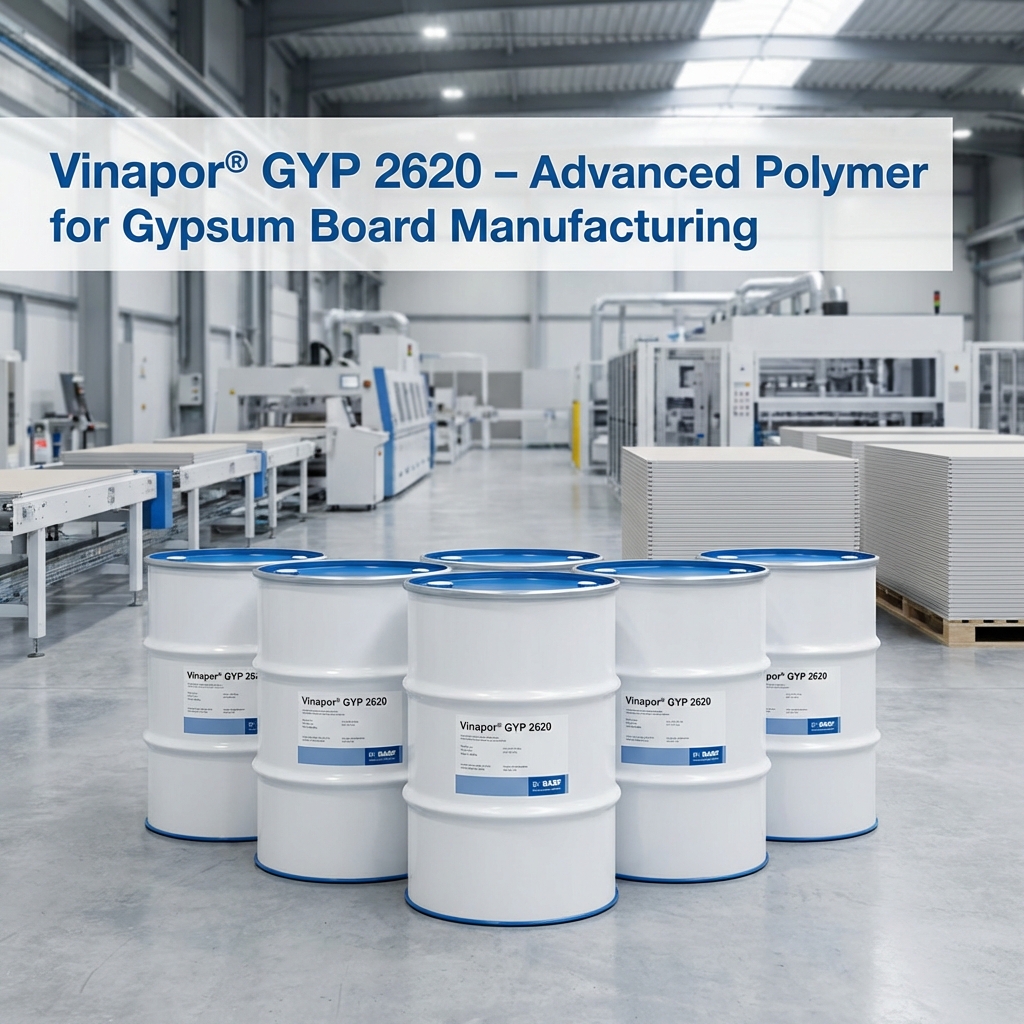
Vinapor® GYP 2620 is an aqueous foaming agent based on sodium alkyl ether sulfate, supplied as a clear, pale-yellow liquid for easy handling in gypsum wallboard plants. Designed as a stable foaming agent, it generates fine, uniform air pores within the gypsum core, supporting consistent density and optimized mechanical strength across the board.
Understand in More Detail
This stable anionic foaming agent is specifically formulated for gypsum wallboard production requiring consistent density control and high mechanical properties. Based on modified alkyl sulfates, it generates fine, uniform bubbles that persist throughout mixing, pouring, and setting processes. The stable foam technology enables predictable density reduction while maintaining excellent mechanical integrity for standard and Type X fire-rated boards. Compatible with glass fiber and fire retardants, it provides robust process control. At VUBS Corporation, we provide comprehensive technical support for Vinapor® GYP 2620, helping manufacturers produce superior lightweight gypsum wallboards.
Key Features
Applications
Technical Specifications
| Parameter | Specification |
|---|---|
| Chemical Type | Anionic foaming agent based on sodium alkyl ether sulfate |
| Physical Form | Clear, pale-yellow aqueous liquid |
| Dosage Range | 0.02–0.10% by weight of stucco (dry gypsum) |
| Foam Stability | Stable foam with persistent bubble structure |
| Bubble Characteristics | Fine, uniform air pores throughout gypsum matrix |
| Density Reduction | 10-20% typical for standard gypsum wallboards |
| Target Applications | Standard and high-strength gypsum wallboards, Type X fire-rated boards |
| Compatibility | Glass fiber, fire retardants, superplasticizers, retarders |
| Shelf Life | 12 months in original sealed packaging |
| Storage Temperature | 10-30°C, protect from freezing and direct sunlight |
| Standards Compliance | ASTM C1396 for gypsum wallboard production |
Technical Support and Availability
Vinapor® GYP 2620 is available ex-stock at VUBS Corporation with comprehensive technical support. Our team provides formulation guidance, application assistance, and gypsum board production optimization support.
We at VUBS CORPORATION combine BASF's cutting-edge foam technology with practical application expertise to help you develop superior lightweight gypsum wallboard systems. Contact us for technical data sheets, starting point formulations, and production optimization recommendations.
Frequently Asked Questions
How does foam control gypsum board density and why is this important?
Foaming agents like Vinapor® GYP 2620 introduce controlled air bubbles into the gypsum slurry before it sets. These air voids remain in the final board, reducing overall density (weight per volume). Density control is critical for several reasons: Weight Reduction makes boards easier to handle, transport, and install, reducing labor costs and physical strain on workers. Structural Load minimizes dead load on buildings, particularly important for ceiling applications and multi-story construction. Transportation Efficiency reduces shipping costs and carbon footprint as lighter boards mean more square feet per truck. Material Cost Optimization as air replaces gypsum allowing raw material savings while maintaining required performance. The foaming agent creates fine, stable bubbles that distribute uniformly throughout the gypsum matrix. For strong gypsum wallboards using GYP 2620, the foam is highly stable, creating a robust pore structure that maintains mechanical integrity despite reduced density. Typical density reductions of 10-20% are achievable while meeting or exceeding ASTM C1396 performance requirements for standard gypsum board.
What is the difference between stable and unstable foaming agents?
Vinapor® GYP 2620 is a stable foaming agent, meaning the bubbles it creates persist throughout the mixing, poaming, and setting process, remaining in the final cured board. This creates many fine, small air voids uniformly distributed. Benefits include predictable, consistent density control, excellent quality control, and suitability for strong gypsum boards where mechanical integrity is critical. In contrast, unstable foaming agents (like GYP 3711 and 3110) create bubbles that begin to coalesce and collapse even during processing. This creates fewer, larger voids with some air escaping before the gypsum sets. Benefits include lower dosages required for similar density reduction, greater weight reduction potential, and different pore structures affecting properties like thermal insulation. The choice depends on product requirements: GYP 2620 stable foam is preferred for standard and Type X fire-rated boards requiring maximum strength, commercial construction applications, and situations where process robustness and consistency are priorities. Unstable foam agents are chosen for lightweight ceiling boards, applications where maximum weight reduction is desired, and scenarios where slightly reduced mechanical properties are acceptable trade-offs. Many manufacturers use combinations optimizing the benefits of both. VUBS Corporation can recommend optimal foaming strategies for specific gypsum board products.
What dosage is typical and how does it affect board properties?
Vinapor® GYP 2620 dosages typically range from 0.05-0.3% by weight of dry gypsum (stucco), with specific amounts depending on target density and board thickness. At Low Dosage (0.05-0.10%), expect minimal density reduction of 5-10%, slight weight reduction, maintained high mechanical strength, and suitability for applications where strength is critical. At Medium Dosage (0.10-0.20%), achieve moderate density reduction of 10-15%, noticeable weight reduction improving handling, balanced strength and weight, and typical for standard 1/2-inch and 5/8-inch wallboard. At High Dosage (0.20-0.30%), see significant density reduction of 15-25%, substantial weight reduction, some reduction in mechanical properties but still meeting standards, and better suited for ceiling applications or lightweight products. Effects on properties include Compressive Strength decreases somewhat with increasing foam but remains adequate for wallboard applications, Flexural Strength shows moderate decrease at higher foam levels, Nail Pull Resistance can decrease slightly but meets standards with proper dosage, Fire Resistance typically maintained or even improved due to increased porosity slowing heat transfer, Thermal Insulation improves with increased air content, and Screw Holding may decrease at very high foam levels. Optimal dosage balances cost savings from material reduction, weight benefits for handling and transport, and maintaining required performance standards. VUBS Corporation provides technical support for dosage optimization and quality control protocols.
Can GYP 2620 be used for fire-rated Type X gypsum board?
Yes, Vinapor® GYP 2620 is highly suitable for Type X fire-rated gypsum board production. Type X boards must meet stringent fire resistance requirements (typically 1-hour fire rating for 5/8-inch thickness per ASTM C1396 and UL testing). The stable foam from GYP 2620 provides several advantages for fire-rated applications: Uniform Pore Structure from stable bubbles creates consistent thermal properties throughout the board, critical for reliable fire performance. Maintained Core Integrity as strong foam structure prevents core crushing or collapse during fire exposure. Glass Fiber Compatibility works well with glass fiber reinforcement commonly used in Type X boards. Controlled Density Reduction allows weight savings without compromising fire resistance, as air voids can actually slow heat transfer. Consistent Manufacturing as stable foam provides robust process control meeting tight specifications for fire-rated products. Typical Type X formulations incorporate GYP 2620 at 0.10-0.20% combined with glass fiber (1-3%), vermiculite or other fire-resistant fillers, and potentially boric acid for additional fire protection. The foam allows achieving the required density (typically 35-45 pcf or 560-720 kg/m³) while meeting the 1-hour fire resistance standard. Some manufacturers use combinations of stable and unstable foam to optimize both fire performance and weight reduction. VUBS Corporation can provide formulation guidance for Type X and other specialty fire-rated gypsum products ensuring UL and ASTM compliance.
Important Testing & Liability Disclaimer: The technical specifications and performance data presented herein are derived from controlled laboratory conditions and standardized testing environments. Actual performance may vary significantly based on application-specific conditions, formulation variables, environmental factors, and processing parameters. All customers are strongly advised to conduct comprehensive application testing and validation trials prior to commercial-scale production or project deployment. VUBS Corporation supplies products strictly on an "as-is" basis and expressly disclaims all liability for any direct, indirect, incidental, consequential, or punitive damages arising from product use, application, or performance. Customers assume full and sole responsibility for product suitability assessment, application testing, quality control, and all associated risks. Due to strong market demand and limited inventory availability, procurement decisions should be made expeditiously following successful validation testing. For technical consultation and sample procurement, please contact our team.
Interested in Vinapor® GYP 2620?
Get technical specifications, request samples, or speak with our experts for application support.
More Polymers & Additives for Gypsum Board Applications
Explore other BASF products in this category
Vinapor® GYP 3711
Optimized Foaming Agent for Lightweight Gypsum Boards
Vinapor® GYP 3711 is an anionic aqueous foaming agent based on modified short-chain alkyl sulfates, developed specifically for gypsum wallboard production. It delivers strong foam power with reduced foam decomposition, enabling the formation of mid-size, well-controlled bubbles at relatively low dosage levels during production.
Learn MoreVinapor® GYP 3110
High-Power Foaming for Ultra-Lightweight Wallboards
Vinapor® GYP 3110 is an anionic aqueous foaming agent with very high foam power, also based on modified short-chain alkyl sulfates for gypsum wallboard applications. It is engineered to generate coarser bubbles easily, making it especially suitable for producing ultra-lightweight, low-density gypsum boards.
Learn More