Vinapor® GYP 3711
Optimized Foaming Agent for Lightweight Gypsum Boards
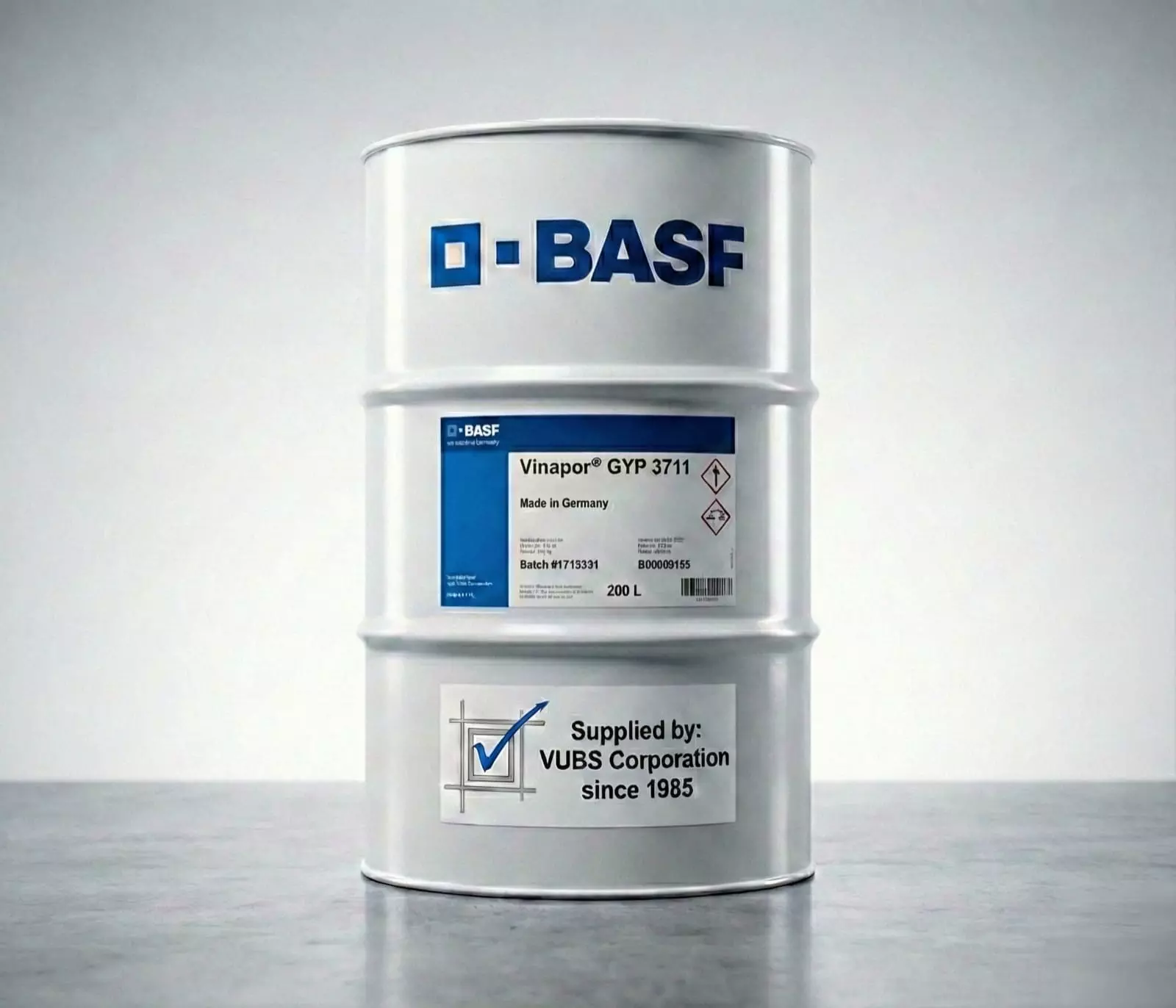
Vinapor® GYP 3711 is an anionic aqueous foaming agent based on modified short-chain alkyl sulfates, developed specifically for gypsum wallboard production. It delivers strong foam power with reduced foam decomposition, enabling the formation of mid-size, well-controlled bubbles at relatively low dosage levels during production.
Understand in More Detail
This mid-bubble foaming agent delivers optimized weight-strength balance for premium lightweight gypsum wallboard production. Based on modified short-chain alkyl sulfates, it provides strong foam power with reduced decomposition, creating well-controlled mid-size bubbles at low dosage levels. The balanced foam stability reduces board weight while preserving edge integrity, nail pull resistance, and mechanical performance. Compatible with superplasticizers for water reduction and faster drying, it enables energy-optimized production. At VUBS Corporation, we provide technical support for Vinapor® GYP 3711, helping manufacturers develop premium lightweight boards meeting stringent international standards.
Key Features
Applications
Technical Specifications
| Parameter | Specification |
|---|---|
| Chemical Type | Anionic foaming agent based on modified short-chain alkyl sulfates |
| Physical Form | Aqueous liquid dispersion |
| Dosage Range | 0.05–0.15% by weight of stucco (dry gypsum) |
| Foam Stability | Unstable foam with controlled bubble coalescence |
| Bubble Characteristics | Mid-size, well-controlled bubbles for weight-strength balance |
| Density Reduction | 15-25% typical for lightweight gypsum wallboards |
| Target Applications | Lightweight wallboards, residential construction, ceiling boards |
| Compatibility | Superplasticizers for water reduction, standard gypsum additives |
| Shelf Life | 12 months in original sealed packaging |
| Storage Temperature | 10-30°C, protect from freezing and direct sunlight |
| Standards Compliance | ASTM C1396 for lightweight gypsum wallboard production |
Technical Support and Availability
Vinapor® GYP 3711 is available ex-stock at VUBS Corporation with comprehensive technical support. Our team provides formulation guidance, application assistance, and lightweight gypsum board optimization support.
We at VUBS CORPORATION combine BASF's cutting-edge foaming technology with practical application expertise to help you develop superior lightweight and high-strength gypsum wallboard systems. Contact us for technical data sheets, starting point formulations, and production parameter recommendations.
Frequently Asked Questions
What makes GYP 3711 an unstable foaming agent and what are the advantages?
Vinapor® GYP 3711 is classified as an unstable foaming agent because the foam bubbles it creates begin to coalesce (merge together) and partially collapse during the gypsum slurry processing and early setting stages. This instability is actually a designed feature, not a defect. The mechanism involves creating initial fine bubbles during mixing that then progressively combine into mid-to-coarse bubbles before the gypsum fully sets. Advantages include Lower Dosage Requirements as unstable foam is more efficient per unit, often requiring 20-40% less than stable foam agents for similar density reduction, reducing cost. Greater Weight Reduction Potential creates larger voids achieving lower final densities with comparable mechanical properties. Different Pore Structure with mid-size bubbles can optimize certain properties like thermal insulation or sound dampening. Reduced Foam Decomposition compared to more unstable agents provides a balance between foam efficiency and process control. Easier to handle during installation due to lighter weight with maintained adequate strength. Cost-Effectiveness through both lower dosage and material savings from density reduction. GYP 3711 is ideal for lightweight gypsum wallboards in residential and light commercial construction, ceiling boards where weight is critical and mechanical demands are moderate, and applications optimizing cost-to-performance ratio.
How does the mid-bubble size distribution affect board performance?
Vinapor® GYP 3711 generates mid-size bubbles (larger than stable foam like GYP 2620, smaller than very coarse foam from GYP 3110), creating a specific pore structure with distinct performance characteristics. Mechanical Properties show moderate compressive and flexural strength, lower than fine-bubble stable foam but higher than coarse-bubble unstable foam, providing good balance for standard wallboard applications. Density Reduction achieves substantial weight savings (15-25% typical) while maintaining structural integrity for wall and ceiling use. Thermal Insulation improves compared to dense boards, as mid-size air pockets provide thermal resistance while avoiding the extreme porosity that might compromise strength. Sound Dampening benefits from the mixed pore structure providing good acoustic absorption. Surface Quality remains excellent as the pore size is small enough to avoid telegraphing through paper facings. Nail and Screw Holding maintains adequate performance for standard fastening requirements. Fire Resistance can be maintained with appropriate formulation including fire-resistant additives. The mid-bubble structure represents an optimized compromise: better strength than very lightweight boards, better weight reduction than high-density boards, easier installation than heavy boards, adequate performance for most residential and light commercial applications, and cost-effective through material and dosage efficiency. This makes GYP 3711 extremely popular for standard 1/2-inch and 5/8-inch wallboard in residential construction.
Can GYP 3711 be combined with stable foaming agents like GYP 2620?
Yes, combining Vinapor® GYP 3711 (unstable, mid-bubble) with GYP 2620 (stable, fine-bubble) is a common industry practice offering synergistic benefits. The blended approach typically uses 30-70% GYP 3711 and 30-70% GYP 2620 (total foam agent 0.1-0.3% on gypsum). Advantages include Optimized Pore Structure creating a bimodal distribution with both fine and mid-size bubbles, balancing strength and weight reduction. Enhanced Process Control as the stable component provides baseline consistency while the unstable component boosts efficiency. Balanced Properties achieving better strength than pure unstable foam and better weight reduction than pure stable foam. Flexibility to Adjust ratios to fine-tune density, strength, and cost for specific product requirements. Cost Optimization using more economical unstable foam while maintaining quality from stable foam. Improved Manufacturability with more forgiving processing windows and consistent quality. Example formulations include Standard Wallboard blends of 50/50 GYP 3711/2620 optimizing cost and performance, Lightweight Ceiling Board uses 70/30 GYP 3711/2620 maximizing weight reduction, and Type X Fire-Rated boards employ 30/70 GYP 3711/2620 prioritizing strength and fire performance. The blending approach requires some trial-and-error optimization for specific plant conditions, mixing equipment, and formulations, but offers significant flexibility. VUBS Corporation provides technical support for developing optimized foam blends including dosage recommendations, quality control protocols, and troubleshooting for specific gypsum board products.
What quality control tests are important when using GYP 3711?
Quality control for gypsum board production using Vinapor® GYP 3711 should monitor both the foaming agent and final board properties. For the Foaming Agent itself, verify Concentration of the supplied product to ensure consistent dosing, Foam Generation Capacity through standardized foam tests (modified Ross-Miles or similar), pH and Viscosity to detect any degradation or contamination, and Storage Stability checking for separation or changes over time. For the Gypsum Slurry during Production, measure Slurry Density (before and after foaming) to verify density reduction matches targets (typically 10-25% reduction), Slurry Temperature as foam stability can be temperature-sensitive, Mix Time and Consistency for process repeatability, and Set Time to ensure adequate working time for forming and paper application. For the Final Gypsum Board Product, critical tests include Core Density measured by cutting representative samples (target typically 30-45 pcf or 480-720 kg/m³), Nail Pull Resistance per ASTM C473 (minimum 75 lbf typical), Flexural Strength (breaking load) per ASTM C473, Humidified Deflection testing sag resistance per ASTM C473, Edge Hardness and Face Hardness for surface integrity, Board Thickness and tolerances, and for Type X products, Fire Resistance per UL and ASTM fire testing. Statistical Process Control should track density, mechanical properties, and defect rates with control charts to detect trends before out-of-specification product is made. VUBS Corporation can provide detailed QC protocols, acceptable ranges, troubleshooting guides, and correlations between foam dosage and final properties for optimization.
Important Testing & Liability Disclaimer: The technical specifications and performance data presented herein are derived from controlled laboratory conditions and standardized testing environments. Actual performance may vary significantly based on application-specific conditions, formulation variables, environmental factors, and processing parameters. All customers are strongly advised to conduct comprehensive application testing and validation trials prior to commercial-scale production or project deployment. VUBS Corporation supplies products strictly on an "as-is" basis and expressly disclaims all liability for any direct, indirect, incidental, consequential, or punitive damages arising from product use, application, or performance. Customers assume full and sole responsibility for product suitability assessment, application testing, quality control, and all associated risks. Due to strong market demand and limited inventory availability, procurement decisions should be made expeditiously following successful validation testing. For technical consultation and sample procurement, please contact our team.
Interested in Vinapor® GYP 3711?
Get technical specifications, request samples, or speak with our experts for application support.
More Polymers & Additives for Gypsum Board Applications
Explore other BASF products in this category
Vinapor® GYP 2620
Stable Foaming Agent for Robust Gypsum Wallboards
Vinapor® GYP 2620 is an aqueous foaming agent based on sodium alkyl ether sulfate, supplied as a clear, pale-yellow liquid for easy handling in gypsum wallboard plants. Designed as a stable foaming agent, it generates fine, uniform air pores within the gypsum core, supporting consistent density and optimized mechanical strength across the board.
Learn MoreVinapor® GYP 3110
High-Power Foaming for Ultra-Lightweight Wallboards
Vinapor® GYP 3110 is an anionic aqueous foaming agent with very high foam power, also based on modified short-chain alkyl sulfates for gypsum wallboard applications. It is engineered to generate coarser bubbles easily, making it especially suitable for producing ultra-lightweight, low-density gypsum boards.
Learn More